



FIBC Bags for Chemical Packaging: What Buyers Should Consider
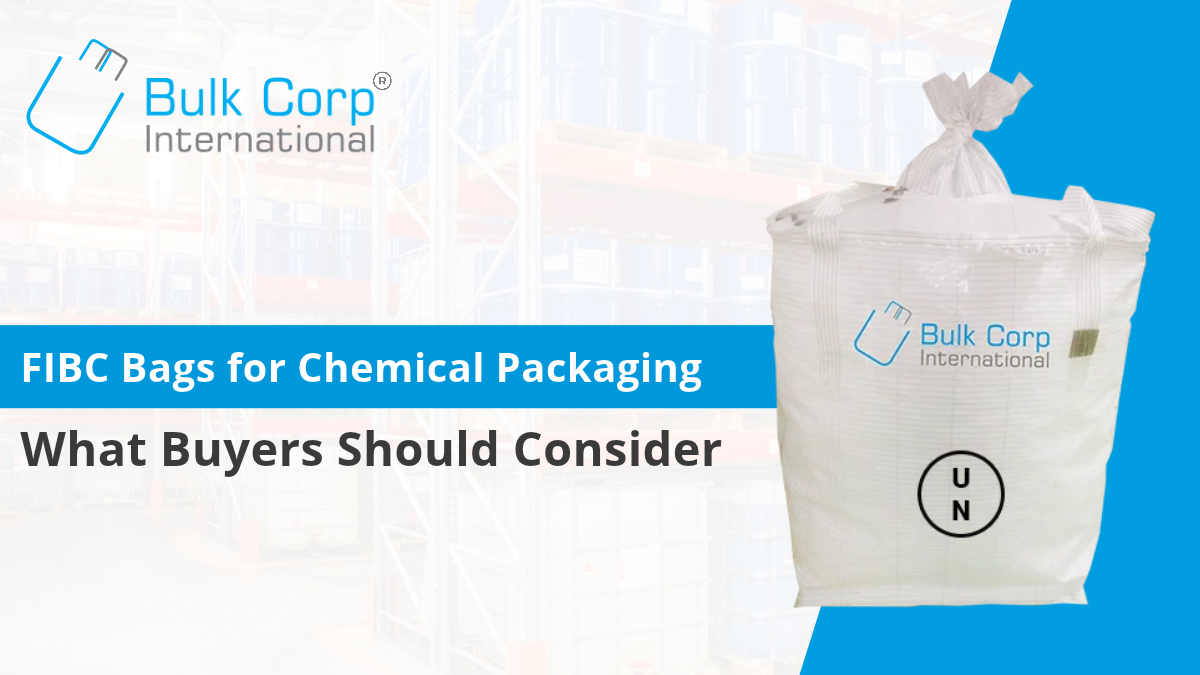
packaging chemicals in bulk requires more than choosing a bag that can hold the required weight. Chemical products can differ significantly in particle size, moisture sensitivity, electrostatic behaviour, handling requirements, and hazard classification. The packaging therefore needs to match both the product and the conditions in which it will be filled, stored, transported, and discharged.
This is why selecting the right FIBC Bags for Chemical Packaging is an important purchasing decision for chemical manufacturers, distributors, exporters, and industrial buyers.
Flexible Intermediate Bulk Containers, commonly known as FIBC bags, bulk bags, or jumbo bags, provide an efficient way to handle large quantities of dry bulk materials. However, chemical applications may require additional features such as UN certification, liners, coated fabric, controlled filling and discharge systems, or electrostatic protection.
Before placing an order, buyers should look beyond bag size and price. Here are the key factors that can help you select an FIBC that fits your chemical packaging requirements.
1. Start With the Chemical You Need to Package
The first question should always be: What exactly will go inside the FIBC?
A bag suitable for a non hazardous mineral powder may not be appropriate for a hazardous chemical compound. Similarly, a free flowing granular product may require a different construction from a very fine powder.
Before discussing specifications with an FIBC supplier, identify important product characteristics such as particle size, bulk density, moisture sensitivity, flow behaviour, chemical properties, and hazardous goods classification.
This information helps determine the fabric construction, liner requirements, filling system, discharge design, and safety features needed for the application.
Buyers should also consider whether the product can react with or affect the packaging material. Compatibility between the chemical and the FIBC or liner material is important for maintaining product quality throughout storage and transportation.
2. Determine Whether UN Certified FIBC Bags Are Required
One of the most important considerations when selecting FIBC Bags for Chemical Packaging is whether the material is classified as dangerous goods.
Standard FIBCs should not automatically be treated as suitable packaging for hazardous products. Where regulations require approved dangerous goods packaging, a properly certified UN FIBC must be selected according to the material classification and applicable transport requirements.
UN flexible IBCs made from woven plastics include different construction categories. These include 13H1 for woven plastic without coating or liner, 13H2 for coated woven plastic, 13H3 for woven plastic with a liner, and 13H4 for coated woven plastic with a liner.
UN certified FIBCs are subjected to defined performance tests. Depending on the applicable requirements, these can include top lift, stacking, drop, tear, topple, and righting tests.
For buyers, the important point is not simply to ask whether a bag is “UN certified.” The certification and tested FIBC specification need to be suitable for the intended material and its regulatory classification.
3. Consider Electrostatic Risks During Filling and Discharge
Fine powders can generate static electricity as they move through equipment and packaging. In some chemical processing environments, uncontrolled electrostatic discharge can create a serious safety concern.
This makes electrostatic properties another important consideration when selecting chemical bulk bags.
FIBCs are commonly categorized as Type A, Type B, Type C, and Type D according to their electrostatic characteristics. The appropriate type depends on factors such as the product being handled, minimum ignition energy, presence of combustible dust, surrounding atmosphere, and the filling or discharge process.
For example, conductive Type C FIBCs are designed to safely dissipate electrostatic charge when they are properly grounded during use. Other environments may call for a different electrostatic design.
UN dangerous goods certification and electrostatic classification address different packaging considerations. Buyers should therefore evaluate both where relevant rather than assuming that one automatically addresses the other.
4. Decide Whether Your Chemical Requires a Liner
A liner can provide an additional protective barrier inside an FIBC.
For chemicals that are sensitive to moisture, contamination, fine particle leakage, or environmental exposure, the liner can be an important part of the overall packaging system.
Different liner constructions may be selected according to the product and filling process. Tubular and shaped liners, for example, can be incorporated into FIBCs depending on the application.
A liner may help reduce powder leakage, provide additional containment, and limit direct contact between the product and the outer woven fabric.
However, buyers should not select a liner based only on thickness. Chemical compatibility, sealing requirements, filling conditions, discharge behaviour, and the required barrier properties should all be considered.
For some applications, coated FIBC fabric may also provide additional protection. The final choice between coated fabric, a liner, or a combination of both depends on the product being packed.
5. Choose the Correct Safe Working Load and Bag Size
FIBC capacity should be matched to the weight and bulk density of the chemical.
Two products with the same weight can occupy very different volumes. A lightweight powder may require a significantly larger bag than a dense chemical granule.
Buyers should therefore provide both the required fill weight and the product’s bulk density when discussing bag dimensions with a supplier.
Safe Working Load, commonly referred to as SWL, indicates the maximum load for which the FIBC has been designed under specified conditions. Selecting the appropriate capacity helps support safer lifting, storage, and material handling.
It is also important to understand that UN certified FIBCs are classified and tested under dangerous goods regulations rather than simply being selected according to the safety factor terminology commonly used for standard non dangerous goods FIBCs.
6. Review Filling and Discharge Requirements
The right top and bottom construction can make a significant difference to day to day operations.
Chemical plants may use automated filling lines, gravity filling systems, enclosed transfer equipment, or controlled discharge stations. The FIBC should work efficiently with the equipment already being used.
A filling spout, for example, can help direct powder into the bag and improve containment during filling. At the discharge stage, different outlet designs can provide more controlled product release.
Buyers should consider how quickly the material needs to flow, whether dust containment is important, whether the bag will be emptied completely, and how operators will interact with it.
Choosing these features during the specification stage can improve handling efficiency while reducing unnecessary product loss.
7. Think About Storage and Transportation Conditions
Chemical packaging does not operate only on the factory floor.
The FIBC may move through warehouses, trucks, shipping containers, ports, and distribution facilities before reaching its final destination. Buyers should consider the entire supply chain when specifying the bag.
Ask where the bags will be stored, how long they may remain in storage, whether they could be exposed to moisture or sunlight, how they will be stacked, and which lifting equipment will be used.
Loop configuration, bag dimensions, construction, pallet compatibility, and container utilization can all affect handling efficiency.
For exporters, it is especially important to consider the requirements that apply to the product and transport method in the destination market.
8. Evaluate Supplier Quality and Documentation
Chemical packaging buyers should look for more than a low unit price.
Consistency is particularly important when large quantities of FIBCs are being used across repeated production batches. Changes in fabric, seams, dimensions, liners, or lifting loops can affect the way bags perform in filling and handling systems.
Before finalizing a supplier, buyers should confirm key points such as:
- Whether the FIBC specification is suitable for the intended chemical
- Whether relevant UN certification and testing documentation is available
- Whether liner and fabric options match the application
- Whether bag dimensions and SWL suit the required fill weight
- Whether filling, discharge, lifting, and printing options can be customized
- Whether production quality and specification consistency can be maintained across orders
Having a clearly documented specification also makes repeat purchasing easier and reduces misunderstandings between procurement, production, logistics, and packaging teams.
Choosing FIBC Bags With the Complete Application in Mind
Buying FIBC Bags for Chemical Packaging is ultimately about matching the packaging to the product, process, safety requirements, and supply chain. Chemical classification, UN requirements, electrostatic properties, liners, SWL, bag dimensions, filling and discharge systems, storage conditions, and supplier documentation should all be reviewed before the final specification is approved. If you are looking for packaging for hazardous chemical materials, explore Bulk Corp International’s UN Certified FIBC Bags and connect with our team to discuss an FIBC configuration suited to your chemical packaging and bulk handling requirements.