



What is the Difference Between Type C and Type D FIBC Bags?
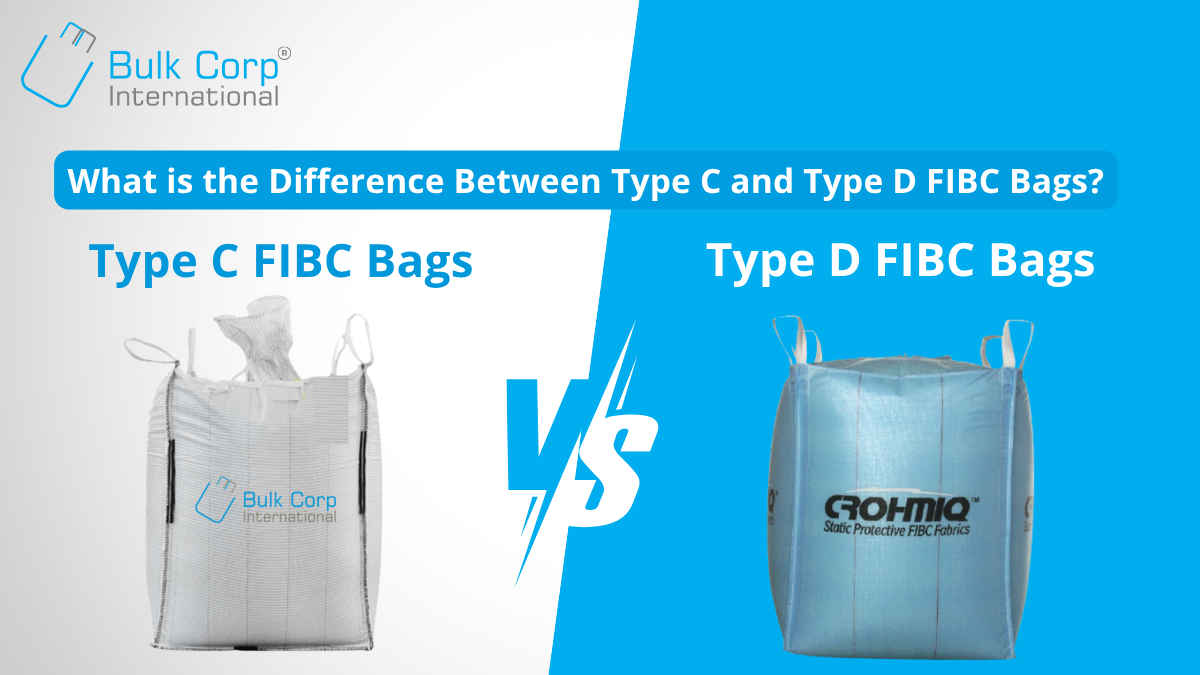
When powders and other dry bulk materials move through an FIBC during filling or discharge, friction between the material and the bag can generate static electricity. In ordinary applications, this may not be a major concern. However, when combustible powders, flammable gases, vapours, or dust clouds are present, uncontrolled electrostatic discharge can become a serious safety risk.
This is where Type C and Type D FIBC Bags become important.
Both are designed for applications where electrostatic hazards need to be controlled, but they work in different ways. The biggest difference is simple: Type C FIBC bags must be properly grounded, while Type D FIBC bags are designed to provide static protection without requiring grounding.
Understanding this difference can help businesses choose an FIBC that better matches their material, operating environment, and handling process.
What are Type C FIBC Bags?
Type C FIBC bags are commonly known as conductive FIBC bags or groundable bulk bags.
They are generally manufactured using non-conductive polypropylene fabric containing interconnected conductive threads or yarns. These conductive elements create a pathway through which accumulated electrostatic charge can move away from the bag.
However, that pathway only works as intended when the bag is correctly connected to an appropriate grounding point.
During both filling and discharge, the conductive network of a Type C bag needs to remain properly grounded so electrostatic charge can be safely dissipated.
This makes Type C bags suitable for certain operations involving:
- Combustible or flammable powders
- Flammable gases or vapours in the surrounding environment
- Combustible dust atmospheres
- Industrial processes with established grounding procedures
The most important consideration is that a Type C bag’s static-control performance depends on a reliable grounding connection.
What are Type D FIBC Bags?
Type D FIBC bags take a different approach to electrostatic protection.
Instead of relying on a grounding connection, they are manufactured using specially designed static-protective and static-dissipative fabric. The construction is designed to prevent dangerous electrostatic discharges without requiring the FIBC to be connected to earth during filling or emptying.
This eliminates the operational step of manually grounding every bag.
Type D bags can therefore be useful in operations where reliable grounding may be difficult to maintain or where businesses want to reduce their dependence on operator-controlled grounding procedures.
They are commonly considered for applications involving:
- Combustible powders
- Flammable or combustible environments
- Chemical processing
- Pharmaceutical materials
- Food and ingredient processing
- Other dry bulk materials requiring electrostatic protection
At Bulkcorp International, Type D FIBC solutions include CROHMIQ® Type D technology, which is designed to dissipate static electricity without requiring a ground or earth connection.
Why Does Grounding Matter for Type C FIBC Bags?
During filling and discharge, dry particles constantly move against the inside surface of an FIBC. This friction can generate electrostatic charge.
Type C bags are designed to transfer this charge through their conductive components to earth. If the grounding connection is missing, damaged, incorrectly connected, or disconnected during handling, the intended static-control system may no longer function correctly.
Businesses using Type C FIBCs therefore need dependable procedures for checking and maintaining grounding connections during operation.
Facilities with established grounding systems, trained operators, and controlled filling and discharge processes may find Type C bags a practical solution.
Why Choose Type D FIBC Bags?
One of the major advantages of Type D bags is the absence of a mandatory grounding connection.
In operations involving multiple filling stations, frequent bag changes, mobile equipment, or complex handling processes, repeatedly connecting and checking ground cables can add another operational step.
Because Type D FIBCs do not depend on a ground connection to provide their intended static protection, they can simplify handling while reducing reliance on manual grounding procedures.
This can make them particularly attractive for facilities looking for a static-protective FIBC solution without introducing a grounding step into every filling and discharge cycle.
However, “no grounding required” does not mean that Type D FIBCs can be used without considering the surrounding environment. The material being packed, liner configuration, contamination, equipment, operating conditions, and applicable safety requirements still need to be evaluated.
Which Industries Use Type C and Type D FIBC Bags?
Static-protective FIBCs are used across industries where fine powders and dry bulk materials can create electrostatic hazards.
Chemical Industry
Chemical powders, additives, pigments, polymers, and other materials may create static electricity during high-speed filling and discharge. Depending on the surrounding atmosphere and handling system, Type C or Type D bags may be selected.
Pharmaceutical Industry
Powdered ingredients and pharmaceutical materials often require controlled handling environments. Static-protective FIBCs can support bulk material movement where electrostatic risks have been identified.
Food Processing
Products such as sugar, flour, starch, and other fine food powders can create combustible dust under certain conditions. Selecting an appropriate FIBC therefore forms part of a broader material-handling safety strategy.
Industrial Manufacturing
Plastic powders, minerals, additives, and various other dry bulk materials may also require electrostatic-control packaging depending on their characteristics and processing environment.
How Do You Choose Between Type C and Type D FIBC Bags?
There is no universal FIBC that is right for every hazardous-material application.
Before selecting between Type C and Type D, consider factors such as:
- Is the product combustible or flammable?
- Can the material generate significant static electricity?
- Are flammable gases, vapours, or dust clouds present?
- Is dependable grounding available at every filling and discharge location?
- Are operators trained to verify grounding connections?
- Will an inner liner be used?
- What filling and discharge equipment will contact the bag?
- What safety standards apply to the facility and application?
If reliable grounding can be maintained throughout the process, Type C may be appropriate. If eliminating dependency on a grounding connection provides an operational advantage, Type D may be considered.
The final selection should always be made according to a proper assessment of the product, process, surrounding environment, FIBC configuration, and applicable safety requirements.
Type C or Type D: Making the Right Choice
The essential difference between Type C and Type D FIBC Bags comes down to how static electricity is controlled. Type C FIBCs use interconnected conductive components and require secure grounding during filling and discharge. Type D FIBCs use static-protective fabric designed to control dangerous electrostatic discharges without needing a ground connection.
Both have important roles in industrial bulk packaging, and choosing between them should be based on the actual handling environment rather than convenience alone.
If your operation requires reliable static-protective bulk packaging without depending on a grounding connection, explore Bulkcorp International’s Type D FIBC Bags. Our team can help you evaluate your material-handling requirements and identify an FIBC configuration suited to your application. Contact Bulkcorp International today to discuss your Type D FIBC requirements and find the right bulk packaging solution for your operation.